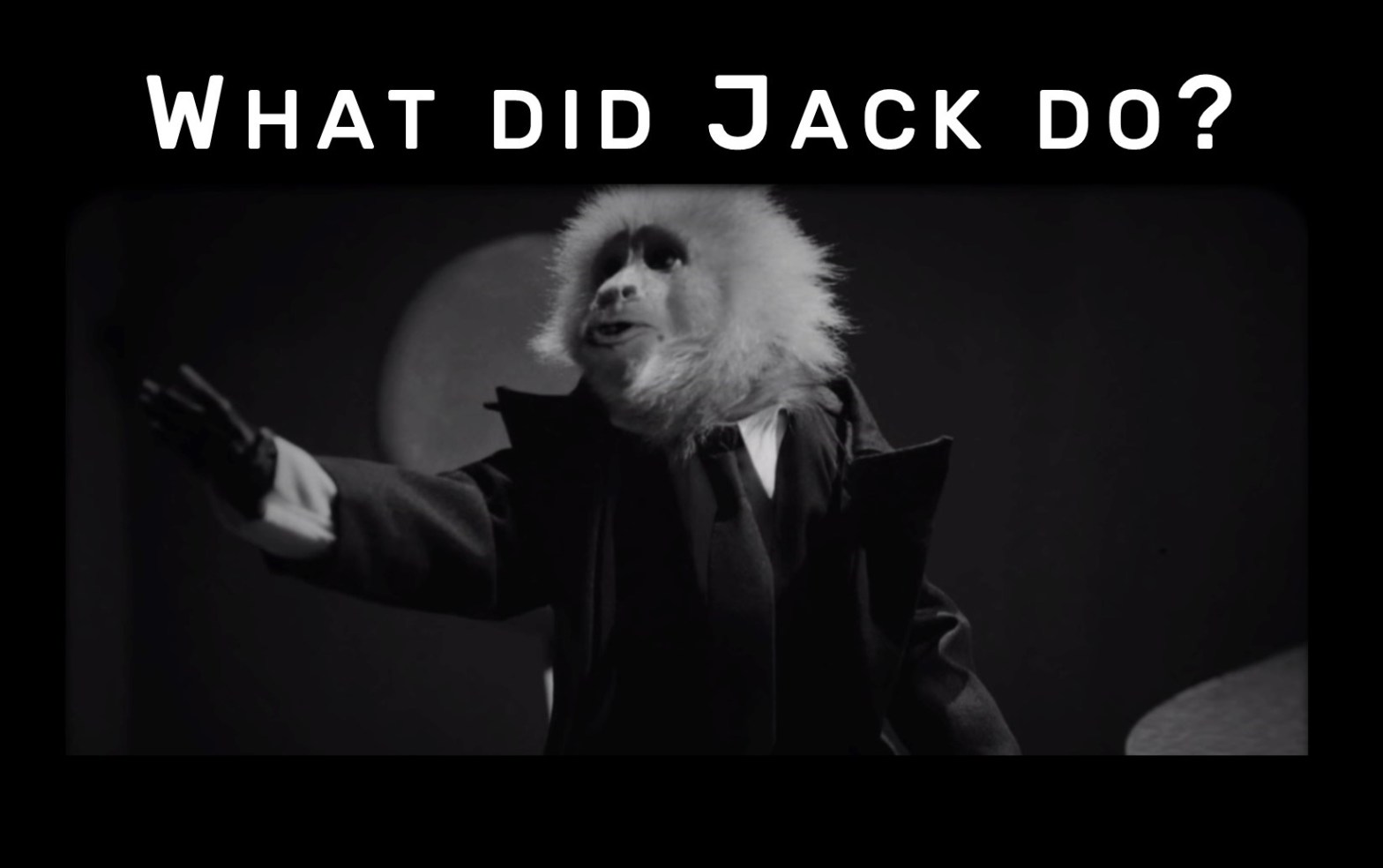
Yes, what you just watched was seventeen minutes of David Lynch interrogating a monkey.
What Did Jack Do?
Likes: This isn’t very insightful when discussing Lynch, but it’s like watching a dream unfold.
Dislikes: This isn’t so always a dislike for me, but trying to gleam any further significance from this work is frustrating.
Bottom Line: It’s like a dream out of the mind of Dale Cooper.
3.5 out of 5. ◆◆◆⬖◇
Some might say (because they’d be just stating facts) that my experience with David Lynch and his style is only through the world of Twin Peaks. Point being, I am not an expert on the guy, but I have come up with some observations that might blow some of your minds. Are you ready?
David Lynch makes weird art.
“Galaxy brain level thinking there Jacob,” I imagine you sarcastically thinking right now. And that’s fair dear reader. It’s no secret that “Lynchian” is a short-hand descriptor for surreal and disturbing imagery. More importantly, the imagery is endlessly interpretable and obscure. Type in Twin Peaks theories and you’ll get millions of results.
People trying to hunt for a greater connection or theory in his art is ironic though because Lynch has never concerned himself with that. The work is there and the audience is left to interpret it. His job is over.
“It makes me uncomfortable to talk about meanings and things. It is better not to know so much about what things mean. Because the meaning, it’s a very personal thing and the meaning for me is different than the meaning for someone else.”
As quoted in My Love Affair with David Lynch and Peachy Like Nietzsche: Dark Clown Porn Snuff for Terrorists and Gorefiends (2005) by Jason Rogers, p. 7
Which makes What Did Jack Do? a classic Lynch project because it is very hard to interpret. What we see in this seventeen-minute black and white project is Lynch, playing a detective, questioning a monkey about a murder. The monkey talks (voiced by Jack Cruz) and wears a suit and tie. (He also sings!) The sound design, something Lynch pays special attention to, transports us to a café or diner near a busy train station.
Characters talk in stereotypical gumshoe lingo and in their back-and-forth, it seems to be slowly revealed that the monkey, Jack, is responsible for a murder of a chicken. The crime was one of passion for his true love, the chicken Toototabon. He is caught in a confession, attempts to run, and is pursued offscreen by the Detective.
That plot summary, like a lot of Lynch’s projects, sounds more coherent than it really is when watching it. Instead, viewing this film is like remembering a dream with logic that is both plainly simple and totally absurd. (Animals are like humans in this world I guess, just go with it) It’s something that kept me enthralled about Twin Peaks and made me keep watching. The way reality suddenly twists into a dream (or nightmare) is incredible.
One of those tricks for twisting reality is oddly enough what I would consider “bad” visual effects. There were a lot of cheap or obviously out of place VFX throughout the run of Twin Peaks, including the newest series. Something about them fit with Lynch’s vision though. Seeing the Giant’s abode in Part 8 or Doppelganger-Diane lifted out of the air after she is discovered would look silly in a Marvel movie, but here, it just works.
The “bad” VFX that just works in What Did Jack Do? is the Jack’s mouth. It looks as if they green screened in human lips for the monkey which clearly do not attach to the rest of his body. Again though, it just makes sense. It adds to the weirdness of the project and the nightmarish quality of the project. I could imagine this as a dream Dale Cooper had while trying to solve the mystery of Laura Palmer.
In terms of greater meaning or thematic understanding, What Did Jack Do? is not a project I feel ready to award. I do know that like the haunting, confusing parts of Twin Peaks, I will probably be thinking about this short film for a while which is a valuable thing. Lynch has given me another weird puzzle to turn over in my mind. Thanks Dave.
 Real Human Bing Movie Thoughts
One thought on “Twin Peaks: Monkey Walk with Me”