For someone who spent time working in a Chinese company, this documentary hit close to home.
American Factory
Likes: Such a strong style with lack of narration that helps to just observe people.
Dislikes: I wonder if a doc set in 1990’s Mexico or Thailand with an American company coming into those countries would be similar? (I kept thinking this throughout)
Bottom Line: Freshman effort from Higher Ground Productions makes me excited to see what’s next.
5 out of 5: ◆◆◆◆◆
By Jacob Schermerhorn
The 2008 Great Recession devastated much of America, but perhaps no where was more poetically felt than in the Northeast/Midwest Great Lakes region, from Buffalo to Detroit, the Rustbelt. The manufacturing plants closing was like tearing the heart out of a body and all that is left is its shell. The Rustbelt of the 2010’s was (and perhaps the 2020’s will also be) defined by this closure and the tremendous feat of finding a sustainable economic future.
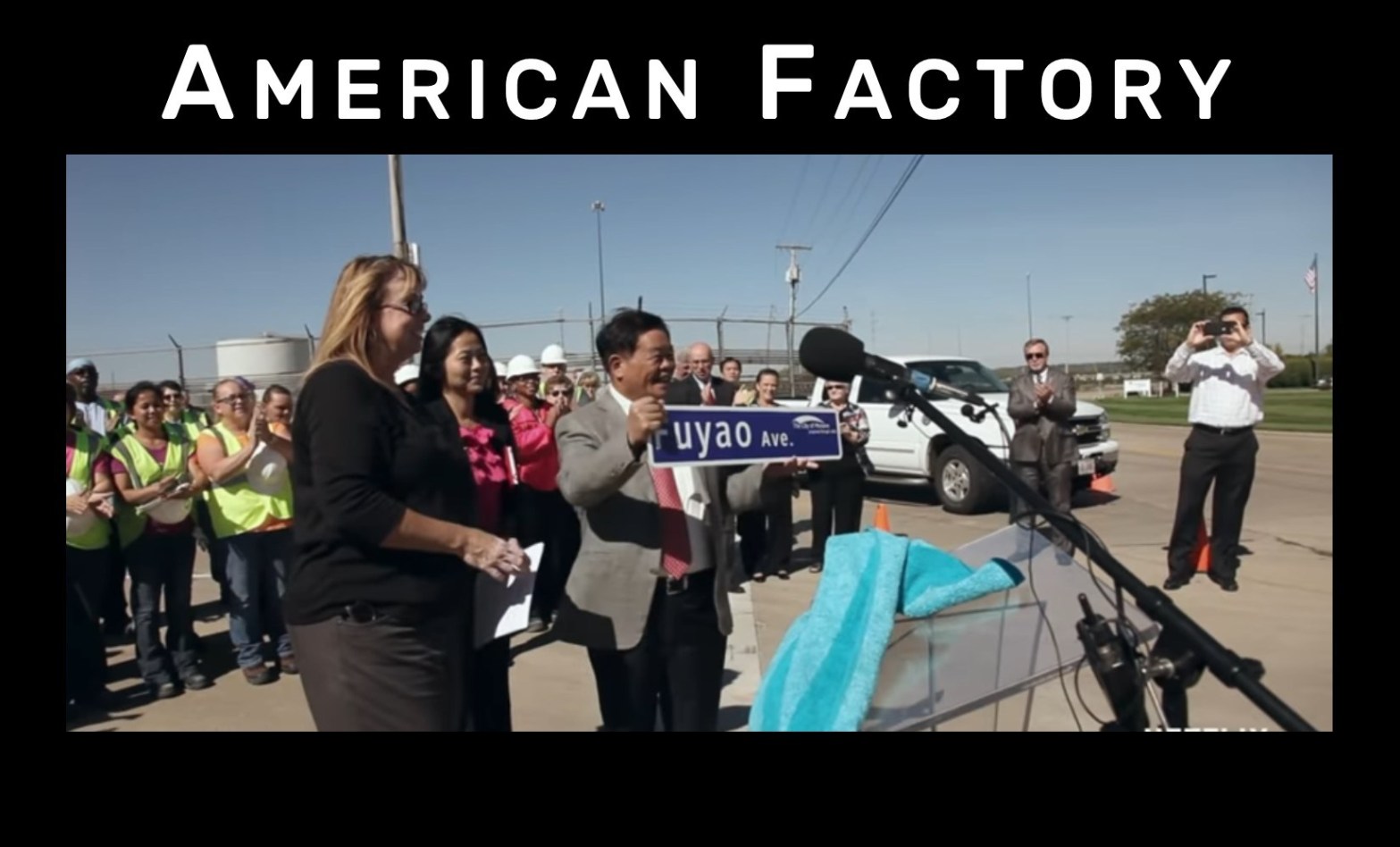
American Factory presents one possible Rustbelt future through a case study of Dayton, Ohio. After the General Motors plant closed in 2008, the city faced an all too familiar recession story with thousands of workers laid off and unable to make ends meet. However, hope emerged when the Chinese company Fuyao Glass started operations in America in 2015. Initial promises and good faith acceptance were strong enough to overrule the ominous lack of a union in this town. Dayton men and women out of work for as many as four years jumped at the opportunity to apply. Over the course of two years, through cultural differences, economic anxiety, corporate pressure, and oftentimes straight-up prejudice, the environment around the factory goes from optimistic to contentious between its American and Chinese counterparts. And it is the change from enthusiasm to suspicion that made American Factory so compelling to me.

With its fly-on-the wall, observational style, this documentary does an excellent job of presenting multiple perspectives. The technique makes each opinion understandable and creates a complex tableau with no clear correct path. The picture becomes like those optical illusions of two ladies kissing or a flower vase.
Two ladies kissing – The Americans see a workplace riddled with safety hazards. Nonexistent gloves or eye protection, extreme temperatures, unsafe forklift operations, improper chemical disposal, the list goes on. All that for low pay (One woman says it is half what she made while GM was in business) a lack of benefits too and an increasingly hostile work environment that intimidates out any discussion of unionizing.
A flower vase – The Chinese see those many of those measures as inefficient and unnecessary and their American counterparts as ungrateful for what they do have. It is revealed that factory workers in China have to work 6 out of 7 days for longer hours and a significantly lower wage. For a country with a population of 1.4 billion, huge economic inequality, and still losing its “developing” status, any job is a good job. Complaining about wages, work hours, health care and safety is pointless.
Quickly those differences devolve to racist and prejudicial judgements being leveled by both sides. Unfortunately, the cultural differences, which are celebrated in a few precious and heartwarming moments (John and Wong’s friendship is so goshdarn touching), instead seem to prove that the sides are incompatible.
While there are many examples, including the most prominent question of union membership, one of my favorites is the roll call. After visiting a glass factory in China, a manager attempts to institute the same procedure in America. The Chinese workers line up in marching order, quickly yell off their assigned numbers, and repeat some phrases rattled off by the foreman. It seems more like a military drill then a factory job, but no one can deny its efficiency. In America, the workers are obviously unreceptive and must be reminded to stand on their number spots. The manager doesn’t even try any call out drills and seems apologetic throughout the procedure. In China, where schools have mandatory days of marching militarily, this procedure must be second nature to workers. America does not have that cultural practice, so of course it fails.

Why does this scene in particular resonate with me? Time to admit something. I worked for a Chinese-Canadian company for three years and it played out so closely to this film. Brief beautiful moments of connection with a majority of division in between. Just like American Factory, the linguistic and cultural differences could result in slight annoyance or outright rebellion. Seeing the parallels between my experiences and the Fuyao factory is disappointing for someone who wants to believe that cultural differences can be overcome.
American Factory is the first documentary from the Obama family’s new production company. But this film is really based on the bones of 2009 doc The Last Truck: Closing of a GM Plant. The team is no stranger to awards (Last Truck was nominated for a Documentary (Short Subject) Oscar), and they have continued being recognized with a nomination for Best Documentary this year.
 Real Human Bing Movie Thoughts