And I agree. Let’s dance and laugh to this charming movie.
Likes: Taika Watiti’s unique voice is both hilarious and heart tugging.
Dislikes: Adult Nazi redemptive arc muddies the thematic waters a bit.
Bottom Line: Guys, it’s okay to laugh at Hitler. He’ll get over it.
4.5 out of 5. ◆◆◆◆⬖
By Jacob Schermerhorn
Two years ago, the internet asked if it was okay to punch American Nazi, Richard Spencer. There are many opinions on both sides of that argument and I personally don’t feel comfortable wading into that complicated issue. However, one thing I hope we can all agree on is that Nazism is evil and deserves to be ridiculed as the hate-filled bile it is. If you agree with those statements, if you think movies like Charlie Chaplin’s The Great Dictator and Mel Brooks’ The Producers are triumphs, then I’m happy to say that you will enjoy Jojo Rabbit.
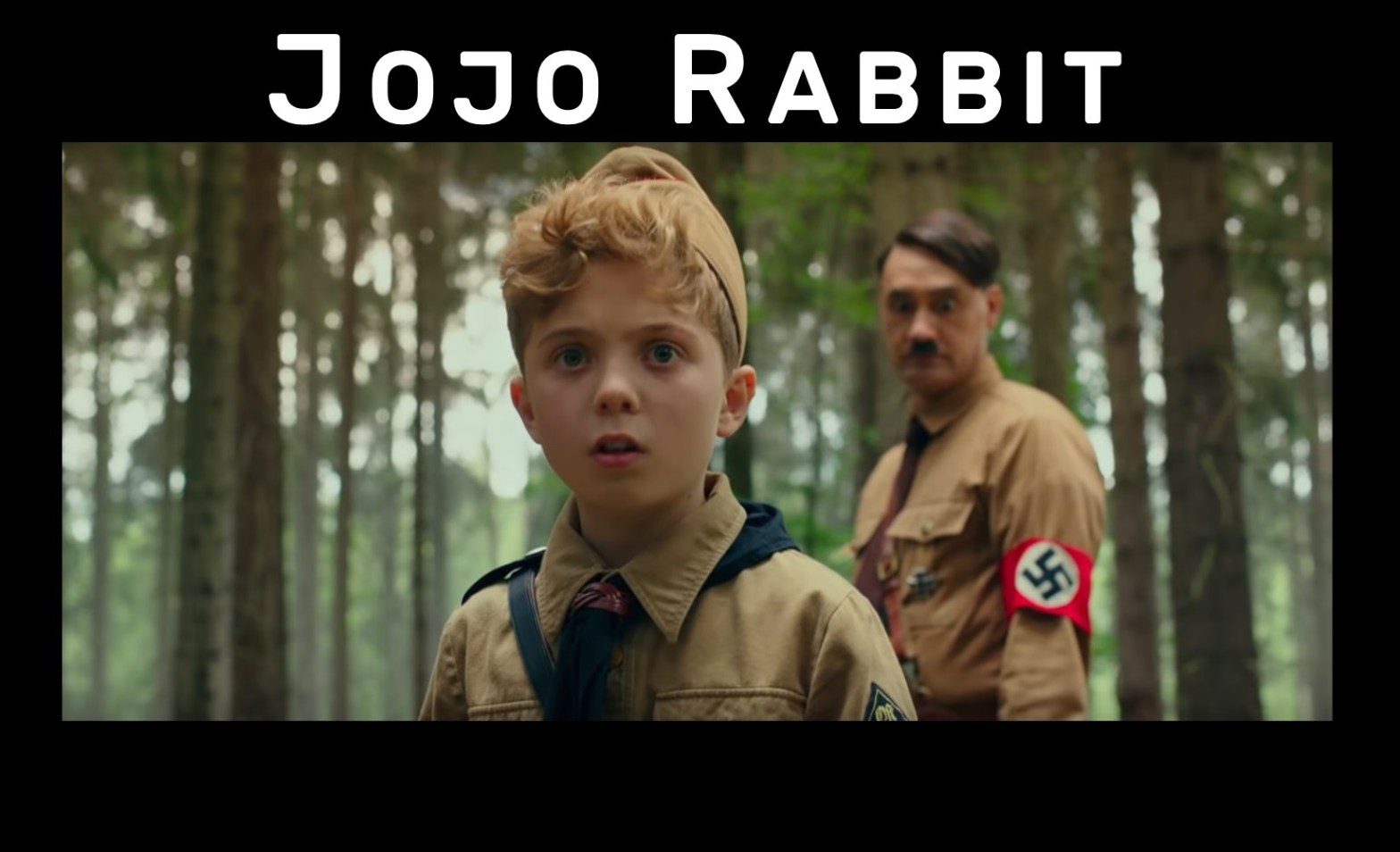
Taika Watiti’s sixth directorial effort is based on the book Caging Skies by Christine Leunens. It sees Watiti’s uniquely comedic voice satirize the Nazi ideology through the protagonist, Johannes “Jojo” Betzler (Roman Griffin Davis). Jojo is a typical ten-year-old: he is still learning how to tie his shoes, he is excited to go to Nazi youth camp (framed like fun summer vacation), and he has a goofy imaginary friend who happens to be Adolf Hitler (Taika Watiti). When an accident with a grenade leads Jojo to spend the rest of the summer at home, much to his and imaginary Hitler’s dismay, he discovers his mother Rosie (Scarlett Johannson) is hiding a Jewish girl Elsa (Thomasin McKenzie). When discovered, Elsa makes it clear that if Jojo reveals her, he and his mother will go down with her. The internal conflict of Jojo struggling with his propaganda-brainwashed mind and his desire to protect his mother becomes the film’s central tension which is backdropped against a provincial German town preparing for a world war that is clearly winding down.
As one might expect given Watiti’s other deeply humanistic films, Jojo ultimately chooses love and empathy over hatred and prejudice. Jojo’s fervent patriotism is clearly illustrated as the desperate longing for acceptance that comes from being an isolated and unpopular child, not as a true commitment to evil. As Elsa says: “You’re not a Nazi, Jojo. You’re a ten-year-old kid who likes dressing up in a funny uniform and wants to be part of a club.”
In the way that, as Jojo rejects Nazism, he becomes more humane, most of the adults in the movie trend in the opposite direction. As they become more entrenched in Hitler’s ideals, their mannerisms become more childish as if to reflect how their ideology is also that childish. Summer camp instructor Fräulein Rahm (Rebel Wilson) spouts ridiculous rumors about Russians and Jews like a kindergartener might to school chums on a bus. Nazi soldier Captain Klenzendorf (Sam Rockwell) uses colored pencils to obsessively design an outrageous uniform complete with Gatling gun and radio emitter that will disrupt enemy morale with loud music. The gestapo agent Deertz (Stephen Merchant) is equal parts cloying but frighteningly intimating and petty as a bureaucratic busybody. However, no character is more shown to be idiotic and childish than Jojo’s imaginary friend Hitler. The dictator, part inner monologue, part inner demon, is played with skill and nuance by Watiti himself. The gimmick never gets old as Waitiki infuses Hitler with a buffoonish nature and some great one-liners. (One moment that especially got me was Hitler proclaiming, “None of this should be weird!” while lying in Jojo’s bed with the covers tucked up to this chin.) However, it is also clear that Hitler is not just a buffoon, but also a terrifying tyrant. As the film progresses and Jojo finds his empathy, Hitler slowly reveals his true colors.
While Jojo Rabbit is definitely hilarious, do not be mistaken by thinking this film is making light of a tremendous tragedy. In a recent Vanity Fair video with actor Stephen Merchant, Watiti said: “What irks me is people who say that comedy is not an effective tool or something to not be taken seriously as an art form. It’s one of the most powerful tools we have to fight against oppression and bigotry and intolerance. It’s to make fun of and poke holes in these belief systems and people who promote hate.” The laughter here in the film is not to diminish the Nazi’s inhumane acts, but to acknowledge the absurdity of their ideas. As the movie itself says: “Dancing is for people who are free.” So let us dance and laugh to this exceptional tour de force of a film.
 Real Human Bing Movie Thoughts